The June 2nd issue of the weekly magazine F features the perspective of Luisa Torsi, one of our #100 #STEM experts, full professor of chemistry at the University of Bari Aldo Moro and adjunct professor at Åbo Akademi in Finland, on the Apulian university's initiative to reduce tuition fees for female students pursuing science degrees.
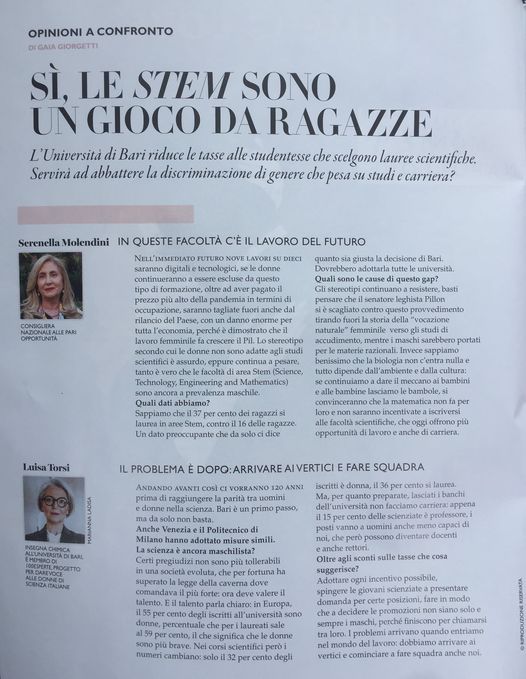
COMPARING OPINIONS
by Gaia Giorgetti
YES, STEM IS A GIRL'S GAME
The University of Bari reduces tuition fees for female students pursuing scientific degrees.
Will it help break down the gender discrimination that weighs on studies and careers?
Serenella Molendini - NATIONAL COUNCILLOR FOR EQUAL OPPORTUNITIES
IN THESE FACULTIES THERE IS THE WORK OF THE FUTURE
In the immediate future, nine out of ten jobs will be in digital and technological fields. If women continue to be excluded from this type of training, not only will they have paid the highest price of the pandemic in terms of employment, but they will also be excluded from the country's recovery, with enormous damage to the entire economy, since it is proven that female employment boosts GDP. The stereotype that women are unsuited to scientific studies is absurd, yet it continues to be pervasive, so much so that STEM (Science, Technology, Engineering, and Mathematics) degrees are still predominantly male.
What data do we have?
We know that 37 percent of male students graduate in STEM fields, compared to 16 percent of female students. This worrying figure alone tells us how right Bari's decision is. All universities should adopt it.
What are the causes of this gap?
Stereotypes persist; consider that Northern League Senator Pillon has railed against this measure, bringing up the idea that women are "naturally inclined" toward childcare studies, while boys are supposedly better suited to rational subjects. Yet we know full well that biology has nothing to do with it, and everything depends on environment and culture: if we continue to tell boys to play with Meccano and girls to play with dolls, they will be convinced that math isn't for them and will be discouraged from enrolling in science faculties, which today offer more job and career opportunities.
Luisa Torsi - Insigna Chair Professor of Chemistry, University of Bari. STEM Expert for "Women and Science"
THE PROBLEM IS AFTER: REACHING THE TOP AND BUILDING A TEAM
At this rate, it will take 120 years to achieve gender equality in science. Bari is a first step, but it alone isn't enough.
Venice and the Milan Polytechnic have also adopted similar measures. Is science still sexist?
Certain prejudices are no longer tolerable in an advanced society, which has fortunately overcome the law of the cave, where the strongest ruled: talent must now prevail. And talent speaks volumes: in Europe, 55 percent of university students are women, a percentage that rises to 59 percent for graduates, which means women are more talented. In science programs, however, the numbers are different: only 32 percent of those enrolled are women, 36 percent graduate. But, no matter how well-prepared we are, once we leave university, we don't make a career: barely 15 percent of female scientists become professors; the positions go to men even less capable than us, who nevertheless can become professors and even rectors.
Besides tax breaks, what else do you suggest?
Adopt every possible incentive, encourage young female scientists to apply for certain positions, and ensure that promotion decisions aren't made exclusively by men, because they end up calling each other. The problems arise when we enter the workforce: we need to reach the top and start working as a team, too.