In the latest issue of Io Donna, journalist Cristina Lacava talks about the #100esperte project and the new area dedicated to #history and #philosophy.
Female database
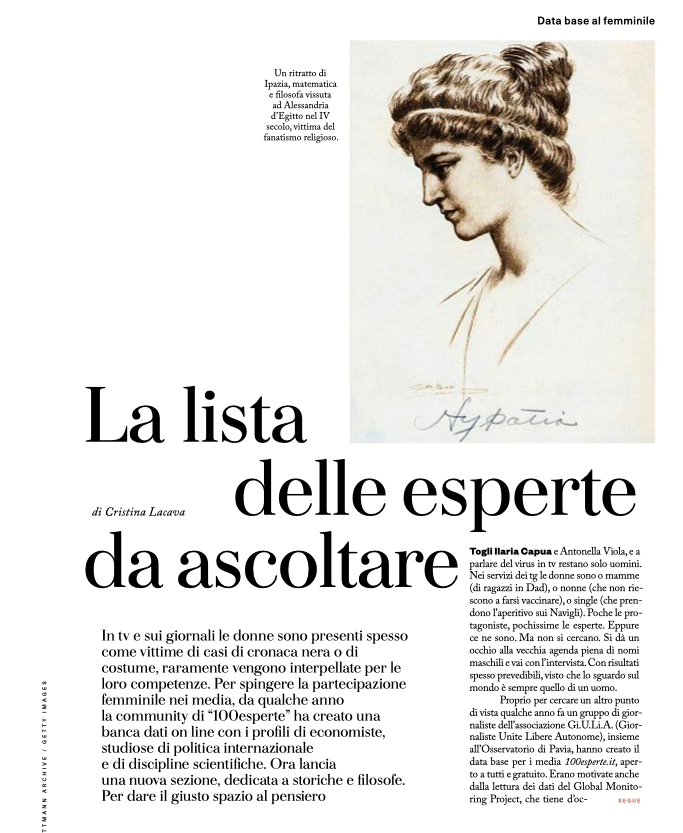
A portrait of Hypatia, a mathematician and philosopher who lived in Alexandria, Egypt, in the 4th century, a victim of religious fanaticism.
The list of experts to listen to
by Cristina Lacava
On television and in newspapers, women are often featured as victims of crime or social issues, rarely consulted for their expertise. To encourage female participation in the media, a few years ago the "100esperte" community created an online database with profiles of economists, international politics scholars, and scholars from scientific disciplines. Now, it's launching a new section dedicated to historians and philosophers, to give proper space to thought.
Take away Ilaria Capua and Antonella Viola, and only men are left talking about the virus on TV. In news reports, women are either mothers (of children in remote learning), or grandmothers (who can't get vaccinated), or singles (having aperitifs on the Navigli canals). Few female protagonists, very few experts. And yet they exist. But they don't seek them out. They just glance at the old diary full of men's names and go on with the interview. With often predictable results, given that the worldview is always that of a man.
Precisely to seek a different perspective, a few years ago, a group of female journalists from the Gi.U.Li.A. (United Free and Autonomous Journalists) association, together with the Pavia Observatory, created the media database 100esperte.it , open to all and free of charge. They were also motivated by data from the Global Monitoring Project, which monitors female visibility in the media, and which in 2015 (the latest data available) was merciless: in Italy, women made up 21 percent of the total; experts accounted for only 18 percent. So they set about the task, with the support of the European Commission and the development of the Bracco Foundation. The list included first those in STEM fields, then those in economics and finance and international politics. The latest additions, with a recently launched section, were historians and philosophers. Particularly interesting to hear in these times, when memory falters and the sense of ethics even more so.
"The Italian average of 21 percent, which included women as both subjects—interviewers, moderators—and objects—protagonists of TV reports and interviewees—was lower than the international average of 24 percent," explains Monia Azzalini, of the Pavia Observatory, who has been part of the team since the beginning. "It's also concerning that some women are the ones cited as victims in crime stories or in lifestyle reports."
A selection based on merit
The 100esperte database is very useful not only for journalists but also for those organizing events or conferences with predominantly male guests. Just a few days ago, Milan's Municipio 1, in the city center, approved a motion urging the City to adopt gender parity "to ensure equal representation" in meetings and seminars organized by Palazzo Marino. In Padua, the City's guidelines recommend that women appear at events not only as moderators, but also as opinion leaders. And the European campaign "NoWoman No Panel – Without Women, We Can't Talk About It," relaunched in Italy by Rai Radio 1, calls for adequate female representation in talks and institutional events. Something is moving.
Meanwhile, the number of experts has risen from 100 to 355, "and the database is open; anyone can nominate or nominate themselves. We evaluate and update them a couple of times a year," explains Monia Azzalini. The selection process is strictly meritocratic. "Depending on the sectors, we consulted highly qualified universities or research institutes, who helped us" (see box). "Naturally, the experts must make themselves available and send us their contact information. Many are academics, but we've also given space to younger ones." No cliques, no favors to the friend of a friend. Results count.
From the squares to the universities
The new entries are very interesting: "Yet women historians aren't consulted by the media as they should be, not even on anniversaries like the 160th anniversary of Italian unification on March 17," laments Cecilia Novelli, professor of Contemporary History at the University of Cagliari, who sits on the scientific committee along with Aldo Cazzullo. "We looked for academics and members of historical societies. I had about seventy contacts, but many didn't like to be listed, so we narrowed it down to 25. A few names? Simona Feci, former president of the Italian Society of Historians; Daniela Luigia Caglioti, president of the Italian Society for the Study of Contemporary History; and Simona Colarizi, professor emeritus of Contemporary History at La Sapienza University in Rome."
Even less "seen," when they have so much to say, are female philosophers, a category that, as Marina Calloni, full professor of Political and Social Philosophy at Milan Bicocca and member of the scientific committee with Michele Nicoletti, professor of Political Philosophy at Trento, says, "has brought about a revolution in academic knowledge thanks to gender studies, with a debate that began in the 1980s, after the season of street protests."
The journey has been long, "because the history of thought has been dominated by men," Calloni emphasizes. Yet, the need for a female perspective is increasingly urgent. "Let's think about the issue of fear, after the murder of Sarah Everard in London, or green development, tied to needs. There's a way of thinking about the world from a different perspective, one that takes emotions and feelings into account," she continues. The database currently contains several dozen women, "not just academics—like Nadia Urbinati, professor of Political Theory at Columbia University in New York, or Adriana Cavarero, honorary professor in Verona—but also young scholars recognized for their research," Calloni concludes. Let's listen to them. It's the missing half.
21%
the visibility of women
in the media in 2015
Global Monitoring Project 2015 data
18%
visibility
of the experts
Global Monitoring Project 2015 data
Choice among the best
Here are some of the most authoritative experts present in the database
The first women to be included in the 100esperte.it database in 2016 were women in STEM (Science, Technology, Engineering, and Mathematics), selected not only by a scientific committee but also by the Gender Center at the University of Milan. Some names include: Ariela Bonfigli, scientific secretary of the Mario Negri Institute; oncologist Elisabetta Dejana; Barbara Mazzolai, director of the Center for Micro-BioRobotics at the Italian Institute of Technology; immunologist Barbara Ensoli; and Daniela Lucangeli, vice-rector of the University of Padua.
In 2018, experts in the economic and financial field were added, indicated by Bocconi University and in particular by Professor Paola Profeta . Among them, the rector of the University of Milan Bicocca Giovanna Iannantuoni , the director of the Museum of Savings in Turin Giovanna Paladino , the vice president of Italian Angels for Growth Paola Bonomo , Veronica De Romanis , professor of European Economics at Luiss in Rome, the economist Lucrezia Reichlin , and the former minister Elsa Fornero .
In 2019, international politics experts selected by ISPI were added, including Annalisa Ciamppi , professor of international law at the University of Verona, and former minister Stefania Giannini . For each, the website lists their expertise, keywords, links to their bios, and email contact information.